

I've been in this industry long enough to know when something shifts from "cool demo" to "actual infrastructure." This week was one of those weeks.
On Friday, Meta closed its acquisition of Assured Robot Intelligence, folding the startup's co-founders, Lerrel Pinto and Xiaolong Wang, into Meta Superintelligence Labs to work alongside Meta Robotics Studio on humanoid technology. The pitch, per Bloomberg, is that Meta wants to be the Android of humanoids, the foundational layer everyone else builds on top of. Mark isn't doing this because it's cute. He's doing it because Tesla, Google, and Amazon are all racing for the same prize, and Amazon already snapped up Pinto's previous company, Fauna Robotics, back in March.
Then I look across the Pacific. Japan Airlines is starting humanoid robot trials at Haneda Airport this month in partnership with GMO AI & Robotics. The hardware appears to be Unitree's, and in the demo footage, you can watch a robot slide payloads down a conveyor belt and shake a coworker's hand. The reason isn't novelty. Japan's working-age population is projected to drop 31% by 2060, and tourism keeps climbing. The labor math doesn't work without machines.
You can see this play out in real time on shows like Door3's GameShow Bot, where a humanoid robot walks up to people on the street, plays trivia games with them, holds up signs, and turns the whole interaction into short-form content built for TikTok and Instagram.
There's a whole company called Robot.com running the same playbook at scale, with a fleet of branded delivery robots and robot dogs rolling through campus sidewalks and city centers as moving billboards. Clients include AWS, Sodexo, and Grubhub. They claim 4.2 million impressions in a single month and 3,000 impressions per mile.
Their whole pitch is that a regular ad gets you reach, but a robot gets you a moment people actually stop for, film, and share. The mile becomes the media buy.
While everyone was watching humanoid hype reels, Bot Auto quietly delivered its first fully humanless commercial truckload on April 29. No safety driver. No remote operator. No in-cab observer. A 231-mile overnight haul from Houston to Hutchins, Texas, departing at 1:16 a.m. and arriving at 4:57 a.m., as FreightWaves reported. It wasn't a pilot. It was a paid delivery to a customer's loading dock.
Bot Auto isn't alone. Gatik became the first company in North America to deploy fully driverless trucks at commercial scale in January, running daily routes for Fortune 50 retailers across Texas, Arkansas, and Arizona. Aurora has tripled its driverless lane network across the Sun Belt and aims to exit 2026 with more than 200 driverless trucks in operation, per its Q4 shareholder letter. Kodiak is hauling fracking sand in the Permian Basin. Plus AI is targeting 2027.
Why I'm paying attention now
For years the conversation around AI was about chatbots and image generators. Software stuff. The kind of automation that replaces the email you didn't want to write anyway. What's happening right now is different. Physical AI, the merger of intelligence and machinery, is what Barclays calls the next frontier, with the industry potentially growing from $2 to $3 billion today to as much as $1.4 trillion by 2035.
That's the part that matters. Not whether one humanoid can fold a shirt on TikTok. Whether the underlying systems can run an airport, a warehouse, a 200-mile freight lane, a hotel housekeeping shift. And the answer, increasingly, is yes.
The analysts in the JAL story are right that these robots aren't very smart yet. Marc Einstein from Counter Research said it plainly. The dexterity gap is real. The reasoning gap is real. Human oversight is still very much in the picture. But the trajectory is what's interesting. Five years out, the picture changes.
I'm not in the doom camp. I'm also not in the "everything will be fine" camp. I'm in the camp that thinks we're underestimating how fast the labor question is shifting underneath us, and how unevenly.
Japan is leaning into humanoids because it has to. Aging population, tightening immigration policy under Prime Minister Sanae Takaichi, and METI publishing official guidelines on robotics and AI to address workforce challenges. The U.S. is leaning into autonomous trucks for a different reason. Driver shortages, hours-of-service rules, and the brutal economics of a 230-mile overnight haul that a robot can do without sleep, without overtime, and with the same precision every time.
What the creator economy taught us is that the platforms shape the behavior. Whoever builds the operating system for humanoid robots, whether that's Meta or Nvidia or someone we haven't heard of yet, will shape what work looks like in the back half of this decade. Whoever owns the autonomous freight network will shape what shipping costs and how fast your stuff arrives.
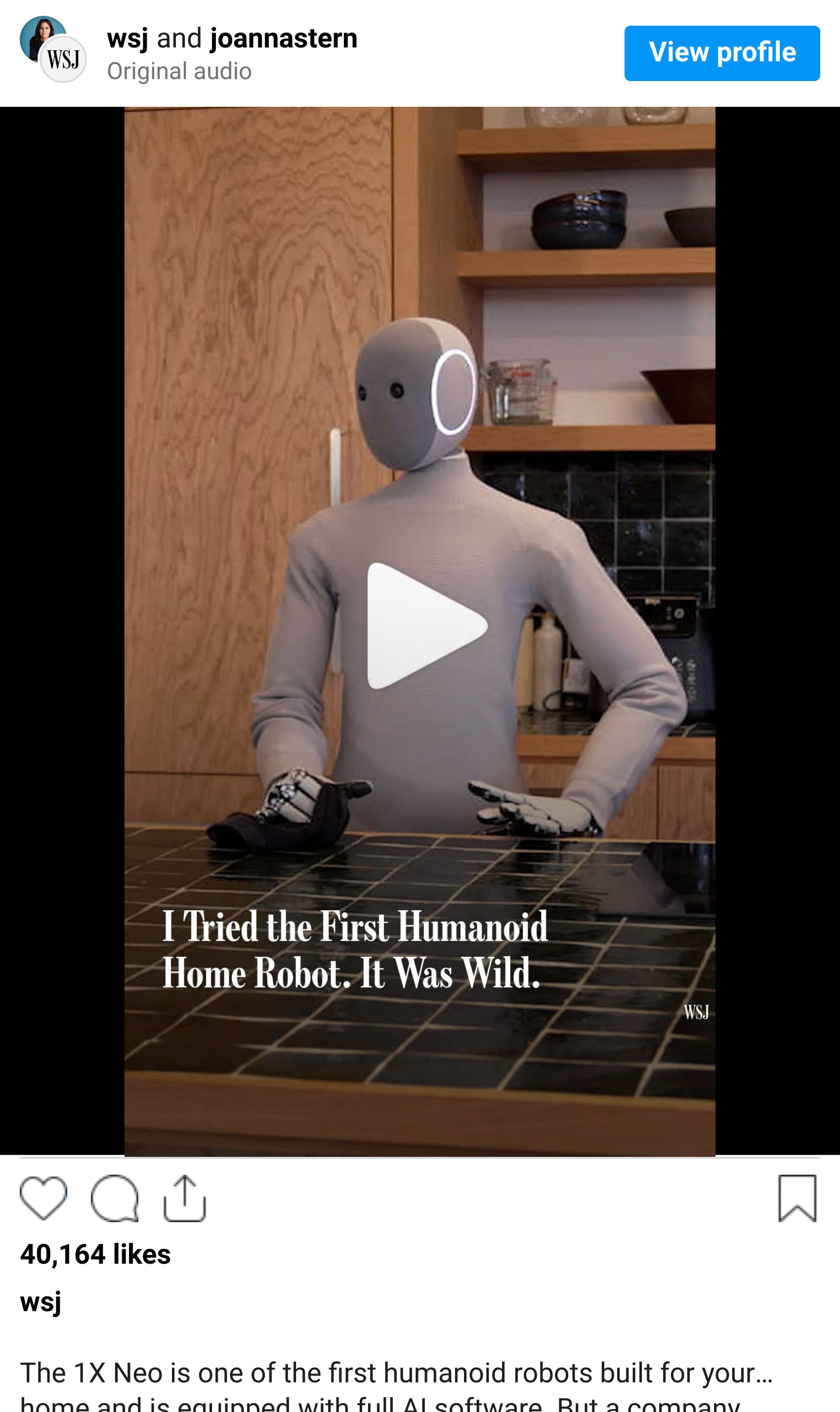
We spent the last fifteen years arguing about what social media did to attention. We're about to spend the next fifteen arguing about what physical AI does to labor.
The robots aren't coming. They’re already here.
In other news
Join 6K+ women in the Women’s AI Challenge.
I came together with four other female creators to share the AI skills and tricks we’ve learned and the response has been amazing to watch.

For 30 days, starting May 1st we are teaching women ways you can use AI for your work, life, finances and personal brand. It’s completely free, plus you can win 5k of prizes for completing the entire thing.
Sign up here: https://www.thewomencreators.com/womens-ai-challenge
Wednesday, May 13, 3:30–6 PM at The Lighthouse Campus.

I'm hosting Realities of Mental Health in the Creator Economy with Creators 4 Mental Health, in partnership with Matt Steffanina's Mad Chill and Movember.
Join us for an afternoon of honest conversation and actual tools — grounding exercises with Jordana Reim, a burnout and boundaries session with Dr. Raghu Appassani, iJustine, and Sidney Raskind in collaboration with the Creators Guild of America, and a Self-Trust Over Self-Pressure workshop with Isaiah Frizzelle. Snacks from That's It, drinks from Olipop, networking after at Gran Blanco.
Always on, always creating, at what cost. Let's actually talk about it, then do something about it.
RSVP here — approval-based, space is limited.
LA, come run with me. Saturday, May 16, 10 AM at Venice Beach.

I'm co-hosting Creator Run Club with Grace Ling and Chris Flight. Free, open to anyone in the creator economy. We run, we mingle, we move before we open our laptops.
It's powered by Creators 4 Mental Health, the nonprofit I founded to make well-being a real pillar of creator culture. We talk about burnout. Less about what we do about it. Showing up on a beach, in motion, is one of those things.
Other headlines to check out:
AI
Creator Economy
Web3
Friendly Reminder
“Your focus on hating yesterday is killing your opportunity to love tomorrow.”
Remember, I'm Bullish on you! With gratitude,

