
Hey Alpha Fam,
If 2025 taught creators anything, it’s that the systems we build on are fragile. Not broken, but constantly changing.
Algorithms shift and monetization rules change quietly. Plus, AI content is flooding feeds faster than anyone can process it. Attention, which already felt scarce, keeps getting more expensive.
In 2026, the creators who win won’t just be great storytellers, a skill that publications like The Wall Street Journal are now noting companies are actively recruiting for. They’ll be smart operators running real businesses, and people who understand how attention turns into trust, and how trust eventually turns into income.
They’ll also need internal skills like resilience and flexibility, something Kudzi Chikumbu from Tubi recently pointed out. Because even the best strategy only works if you can adapt when the ground moves.
Here are the creator trends I’m watching this year, and what they look like in practice.
1. Human signal becomes the most valuable currency
AI-generated content is everywhere, from faceless videos and cloned voices to auto-generated commentary. Some investors are even arguing that AI will make creators less valuable, not more.
Whether or not you agree, that belief is already shaping platforms and budgets. What cuts through isn’t louder content or copying what already works, but clearer human signal. The new “authenticity” is actually leaning into your lived experience and genuine passions, taste and aesthetic, as well as owning your mistakes as lessons.
Formats that involve presence and perspective like live conversations, reporting from the ground, expert interviews, or genuinely community-led work, are harder to fake and easier to trust in an increasingly automated feed.
What to do: have the courage to post before making it perfect, and build at least one format that makes it obvious why you are the one telling this story.
2. Short-form video becomes more like television
Short-form isn’t going away, but it is changing. Instagram Reels generated an estimated $10 billion in ad revenue in 2024, according to Meta disclosures and reporting from The Information. That scale changes how platforms think.
Creators who approach short-form like episodic media, with recurring formats, recognizable beats, and a sense of continuity, are consistently outperforming those chasing one-off viral moments. Either way, shorts still matter for discovery.
You can see this mindset showing up inside creator-led companies too. When MrBeast hired for a Head of Viral Marketing role, it underscored something creators already know: distribution is no longer luck or instinct. It’s a discipline.
At the same time, long-form hasn’t lost its pull. Podcasts continue to command deep attention and budgets, and with platforms like Netflix entering the space, the line between digital media and “real” media is basically gone. YouTube now rivals traditional TV in reach, highlighted by its latest power-move partnership with the Oscars.
This isn’t a short-form versus long-form moment. It’s a full media stack moment.
What to do: focus on consistency and repeatability. Build formats people recognize and return to, and think in seasons rather than posts. Shorts increasingly function like marketing, while podcasts are filling the role talk shows once did.
3. Creators are partners, not performance channels
Brands are increasingly focused on outcomes, and creator-led media spend is growing as a result with companies like Unilever announcing plans to work with tens of thousands of creators. But alongside that growth, more creators are pushing back on being treated like unpaid, results-oriented sales teams. When creators are expected to contribute strategy, creative direction, production, and distribution, performance alone doesn’t reflect the full scope of the work.
What’s emerging instead are longer-term, more embedded relationships. Creator-in-residence roles and extended partnerships are bringing creators in earlier, sometimes before agencies or formal RFPs are involved. These arrangements often include advising and insight alongside content creation, and they work best when creators are treated as collaborators, not just distribution.
When done well, these partnerships reflect reality: many creators are operating as media businesses and subject-matter experts, not just marketing channels.
What to do: negotiate like a business, not a post. Separate compensation for time, expertise, and production from how content is used or amplified, and prioritize longer-term scopes where the work can compound.
4. Income becomes modular, not platform-dependent
Platform payouts keep shifting. YouTube expanded its Shorts revenue sharing, TikTok continues to adjust creator rewards, Instagram experiments with bonuses and payouts, and Facebook is making a quiet comeback with monetization. The pattern is consistent even as the details change: no single stream is stable enough to rely on.
Creators who are building sustainable businesses are stitching together income across multiple sources from platform revenue, newsletters, affiliates, subscriptions, brand partnerships, services, and owned products, so that changes in one area don’t derail everything.
What to do: aim for a mix of revenue streams that gives you leverage. That way, if one platform changes the rules, your business can still function.
5. Compliance becomes part of credibility
The FTC has made it clear that disclosures must be clear and conspicuous. Vague hashtags buried at the end of captions are not enough.
At the same time, the EU Digital Services Act is pushing platforms toward greater transparency and accountability, especially around ads.
This affects creators globally, not just in Europe.
What’s changing beneath the surface is bigger than disclosures. As the industry matures, creators are increasingly being recognized as small businesses rather than hobbyists. From unions and guilds like SAG-AFTRA and the Creator Guild of America, to practical infrastructure being built by companies like The Boring Stuff, there’s growing momentum around clearer scopes of work, usage rights, compensation standards, and mental health considerations.
Credibility now includes how responsibly creators operate and how seriously brands and platforms treat the people they work with. This is also what continues to fuel my work building Creators 4 Mental Health.
What to do: go beyond basic disclosures. Pay attention to the frameworks emerging from SAG-AFTRA’s Influencer Agreement and the Creator Guild of America’s Rider contract, stay informed about state-level conversations around independent contractor protections, and adopt tools and standards that treat your work like a real business. Transparency and compliance are no longer extras; they’re table stakes.
6. Community outperforms virality
Multiple studies show that creators with smaller, loyal audiences often earn more sustainably than those dependent on viral spikes. That’s because repeat viewers, subscribers, and members build momentum over time in a way virality usually doesn’t.
We’re also seeing continued growth among B2B and education creators, especially on platforms like LinkedIn, where what you know is what creates value. In these spaces, influence is built through clarity, consistency, and usefulness rather than reach alone, and community forms around shared problems, not trends.
For many creators, this kind of influence looks less like “going viral” and more like becoming a trusted resource people return to. It’s also why academics and subject-matter experts are starting to find real traction on TikTok and Instagram. As fatigue around the influencer lifestyle sets in, learning and perspective are creating a different kind of value.
What to do: serve a specific audience well. Build one weekly touchpoint your audience can reliably count on, engage where you already show up, learn how to respond to timely moments through your own lens, and let your community grow from there.
7. Creator ecosystems decentralize
Creator hubs are no longer limited to Los Angeles or New York. Miami, Austin, Atlanta, and international cities are becoming meaningful centers for collaboration and deal-making. This shift opens the door to local-first partnerships, regional brand activations, and IRL moments that translate online.
What to do: lean into where you are and what you have access to. Become a signal for your region instead of chasing someone else’s scene.
8. Owned media becomes non-negotiable
Platform volatility is not new, but the stakes are higher. Even mainstream business publications are warning creators about over-reliance on algorithms.
Newsletters, SMS lists, and owned websites are not optional anymore, they are insurance.
What to do: make growing an owned audience a core KPI, not a side project.
9. Live shopping turns creators into conversion engines
If you follow Gary Vaynerchuk, all he can talk about is this!
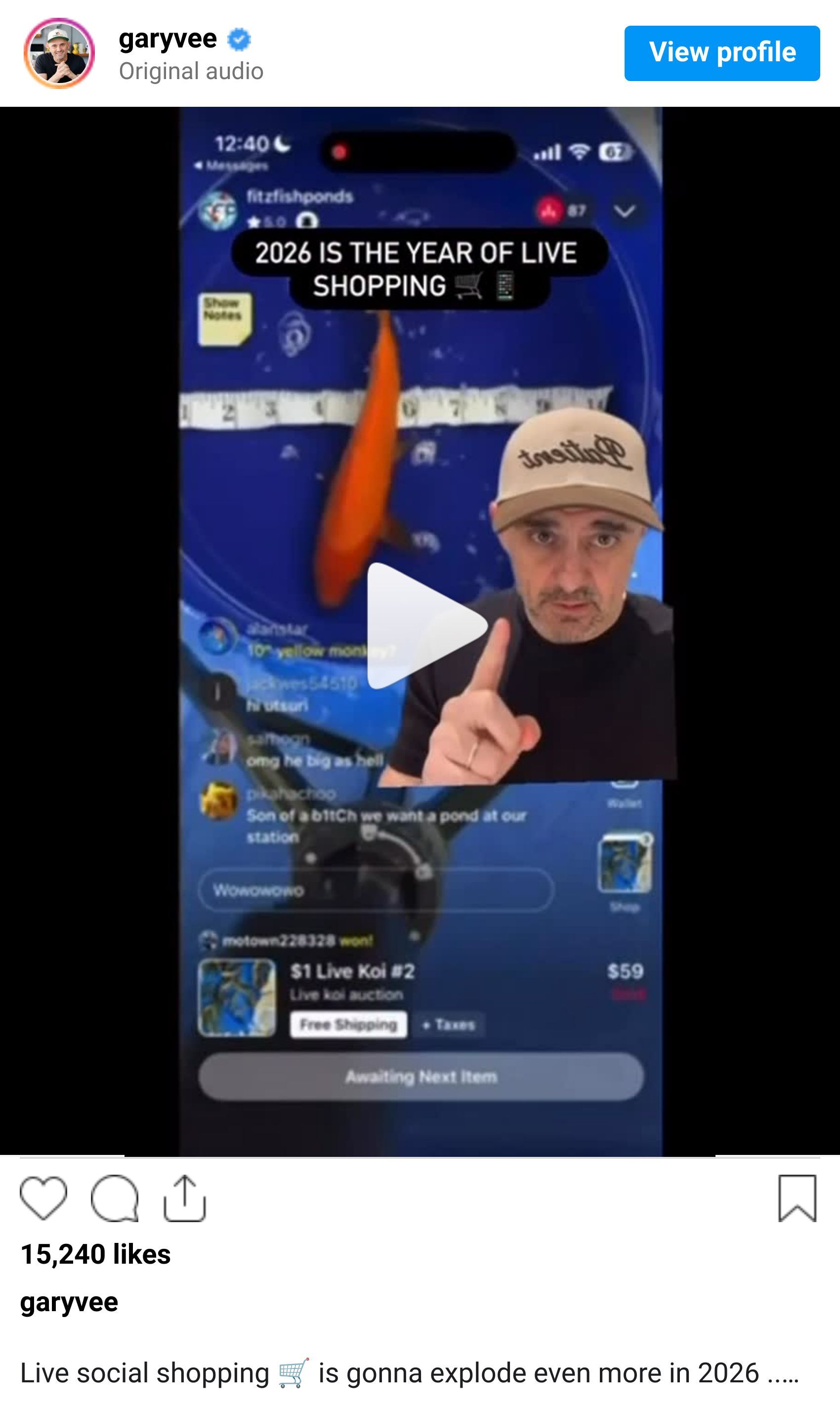
Live shopping is no longer experimental. Platforms are leaning into it because it collapses the funnel: content, community, and commerce in one moment. It’s also a clear monetization pathway and keeps users on these apps for WAY longer.
Creators who already have trust are uniquely positioned here. Live formats reward real-time interaction, product knowledge, and credibility, not just reach. This is especially true in beauty, wellness, fashion, and home.
Platforms like TikTok and Whatnot are where a lot of this experimentation is happening, and the creators who thrive there tend to feel different. They’re less “influencer posting a link” and more like a modern QVC host, part entertainer, part product expert, part community builder.
What to do: approach live shopping as a format, not a feature. Treat it like a show, but also like FaceTime or a hangout with people who already trust you. Give viewers reasons to stay, participate, and come back. One well-run live can outperform weeks of passive affiliate links.
10. IRL becomes a force multiplier, not a replacement
The online world is only getting noisier. As a result, creators who pair strong digital presence with real-world proximity will have an advantage.
This does not mean big conferences or massive events. Smaller, more intimate gatherings like dinners, workshops, salons, and private communities, are becoming deal flow and community growth engines. Brands want creators who feel trusted and known, not just seen.
Some people are calling this an offline or analog renaissance. What it really reflects is a loss of default trust in online systems, combined with growing fatigue. From Gen Alpha to early tech adopters, people are becoming more skeptical of feeds, platforms, and automated experiences they once relied on without question.
At the same time, a growing body of research continues to show the impact of constant screen time and social media on mental health. This shift is not anti-technology. It is a search for signal and sustainability. In a more automated and noisy digital environment, trust is moving back toward people, presence, and proof.
What to do: invest in small, intentional IRL moments that reinforce your online work. The combination compounds trust and leads to higher-quality, longer-term deals.
Hot take:
The real shift in 2026
The throughline here is simple: creators are no longer just creators. They’re media companies, operators, and small businesses navigating an industry that’s rapidly growing up.
And in the middle of all that change, standing out isn’t only about chasing the next format or platform shift. Sometimes it comes from doing the opposite, slowing down, getting clearer on what you actually care about, and building from there. The creators who know themselves, on and offline, are often the ones best positioned to adapt when everything else moves.
Where to find me next…

I’ll be emceeing the Creator Economy Stage from January 8-11. If you’re there, come say hi!
Other headlines to check out:
AI
Creator Economy
Web3
Remember, I'm Bullish on you! With gratitude,

